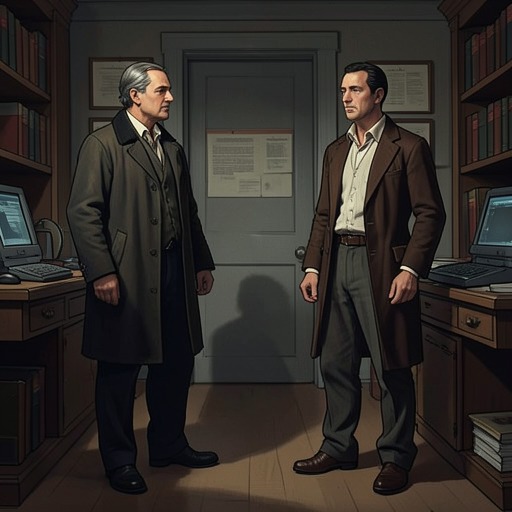
Rob Ryan and Cassie Maddox’s first intimate encounter
In the WoodsRob Ryan and Cassie Maddox’s first intimate encounter turns a trusted, apparently uncomplicated friendship into a relationship neither can return to unchanged. Its decisive movement is from unspoken closeness to a kiss, and then to Rob’s effort to call the night a mistake even as he admits that the old ease between them has become impossible.
From Familiarity to Intimacy
The encounter begins in a setting of routine and care, not a declared romantic overture. Rob is so exhausted and unsettled that undressing feels too difficult; he climbs beneath the duvet still wearing his clothes. Cassie removes her sweater and settles beside him. Without consciously deciding to, he puts his arms around her, and she curls her back against him. Their good-night exchange remains affectionate and teasing, with Cassie telling him to wake her if he wants to.
After a long interval, Rob whispers to ask whether Cassie is awake. They lie still, and he registers the change between them as bodily intensity rather than as a clear decision: the air seems to shimmer, and he cannot tell whether his heart is racing or Cassie’s is pounding against his chest. He turns her in his arms and kisses her. After a moment, she kisses him back. The pause and the reciprocal response matter: the transition happens without a prior declaration, but it is not presented as a one-sided advance.
Rob’s Retrospective Account
Rob later corrects his own account of himself. He recalls claiming that he always chooses the anticlimactic over the irrevocable, then acknowledges that this was a lie: at least once, he did not retreat from the irreversible choice. The confession makes the encounter a reversal in his self-understanding as well as a change in the friendship. His retrospective voice first casts him as someone who avoids decisive consequences, then preserves this night as the exception.
That correction also complicates the way he narrates the scene. Rob insists that neither of them knew what was coming, despite the expectations he imagines other people would have had. He remembers small, ordinary gestures—the way Cassie removes her hair clips and the way he tucks his socks into his shoes so she will not trip over them in the morning—as evidence of their familiar domestic ease. The intimacy grows out of that ease, but afterward those same habits no longer guarantee that the relationship can remain unchanged.
The Morning After
Rob wakes first after what he estimates may have been only an hour or two of sleep. They do not get up until around three. Cassie, tousled and hungry, suggests their usual weekend pattern of a large Irish breakfast; Rob refuses. He cannot face either a conversation about the night or the tacit agreement that would come from avoiding it. The flat suddenly feels cramped, and he notices bruises and scrapes on his stomach, elbow, and thigh, including a deep gouge. The narration records these injuries without establishing their cause.
When Cassie offers him a lift, Rob sees a quick, startled flinch in her eyes and says he will take the bus instead. He finds his shoes under the sofa, makes a half-hearted attempt to wait, then gives up on the two buses and Sunday schedules. Rather than go near Knocknaree while the archaeological site might be deserted, he walks toward home by way of Sandymount Strand, stopping for bad-tasting coffee at a petrol station. He expects Heather to be home and imagines the questions she will ask about his muddy jeans and the missing car. His walk stretches the separation from Cassie into a period of anxious reckoning.
A Friendship That Cannot Reset
On the way home, Rob decides that sleeping with Cassie was one of the biggest mistakes of his life. He cannot use either familiar response to an intimate entanglement: formally beginning a relationship or cutting off communication. Cassie is his partner at work, and he recognizes that a romantic relationship would bring responsibilities he feels unable to manage while he is already struggling to eat, sleep, and function in the investigation. He also knows that the police regulations make such a relationship an additional complication.
The loss he anticipates is more intimate than a change of status. He can no longer stay up drinking with Cassie, tell her about other women, or sleep on her sofa while seeing her simply as a close friend. Even a remembered gesture—the unthinking way she reached into his coat pocket for his lighter in the castle gardens—now belongs to a shared landscape charged with implications. The encounter does not erase their history; it makes their ordinary habits newly difficult to interpret.
When Rob later tells Cassie that Saturday night was a mistake and that they are stuck with what happened, she responds that it need not be a mistake. He insists that it should not have happened and attributes it to his being in a bad state over other matters. Her reply and his refusal leave their disagreement unresolved: he tries to turn the event into an error that can be contained, while she resists treating that judgment as inevitable. The encounter’s consequence is therefore not a settled romance or a clean return to friendship, but a changed bond whose meaning they do not share.